
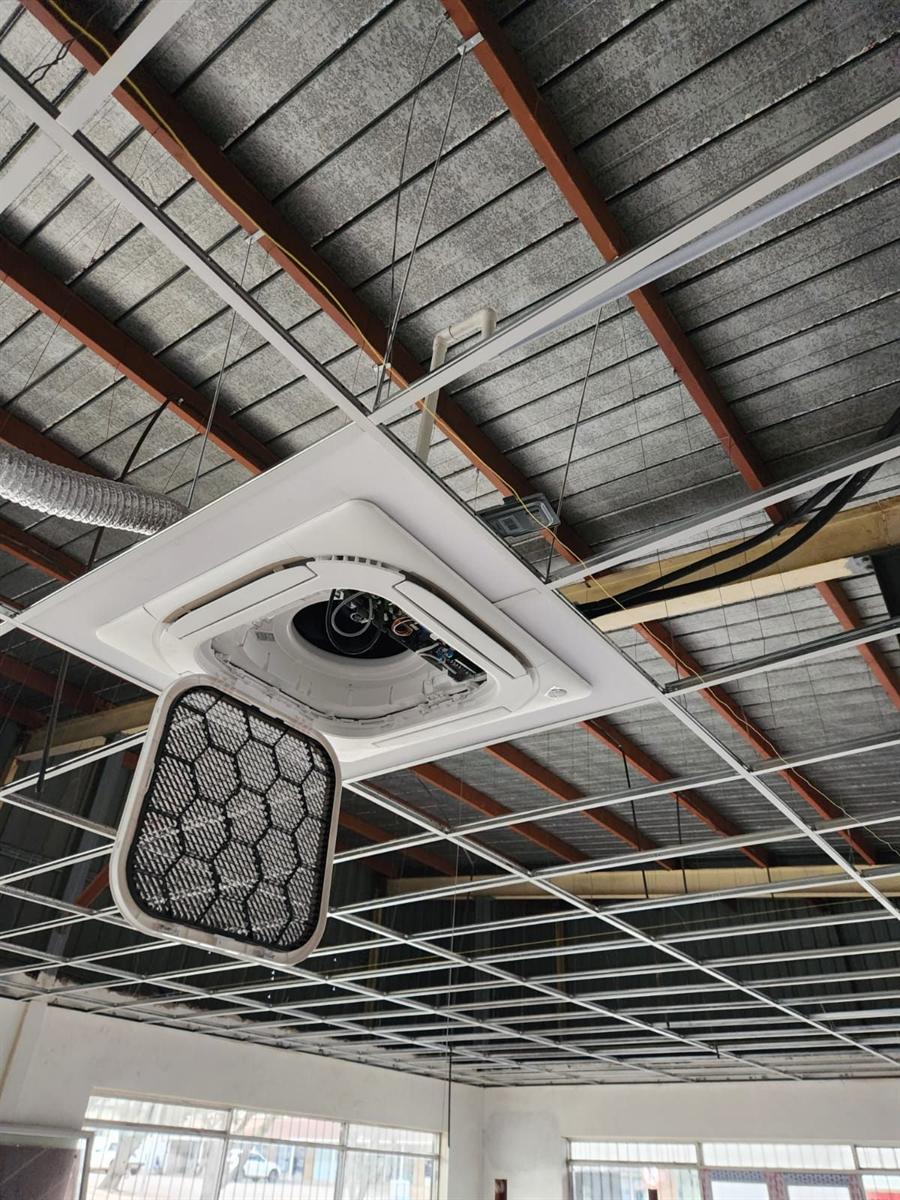
Aircon Service & Maintenance, Gqeberha
The cheapest air conditioning repair is the one you never needed. Scheduled servicing keeps capacity up, running costs down and manufacturer warranties intact.
Gqeberha is hard on air conditioners
Two things make this city tougher on HVAC equipment than most of South Africa: salt and wind.
Salt-laden coastal air attacks aluminium fins and copper tubing on outdoor condensers. Left alone, the fins corrode, the coil loses its ability to reject heat, head pressure climbs, the compressor works harder, and the unit draws more current to deliver less cooling. Owners usually notice it as "it just isn't as cold as it used to be" long before anything actually breaks.
The wind then drives dust, grass seed and fine sand straight into those same coils. A condenser that is 40% blocked is not a maintenance problem you can see from the ground - but it is costing you money every hour the unit runs.
None of this is dramatic. It is just steady, invisible degradation that a clean twice a year almost entirely prevents.
How often should yours be done?
| Environment | Recommended interval | Why |
|---|---|---|
| Home, inland suburbs | Once a year | Light duty, seasonal use |
| Home, coastal belt | Twice a year | Salt corrosion on the outdoor coil |
| Office & retail | Twice a year | Runs all trading hours, filters load fast |
| Restaurants & kitchens | Every 3 months | Grease-laden air fouls coils quickly |
| Workshops & factories | Every 3 months | Dust, swarf and airborne particulate |
| Server & comms rooms | Every 3 months | Continuous duty, zero tolerance for failure |
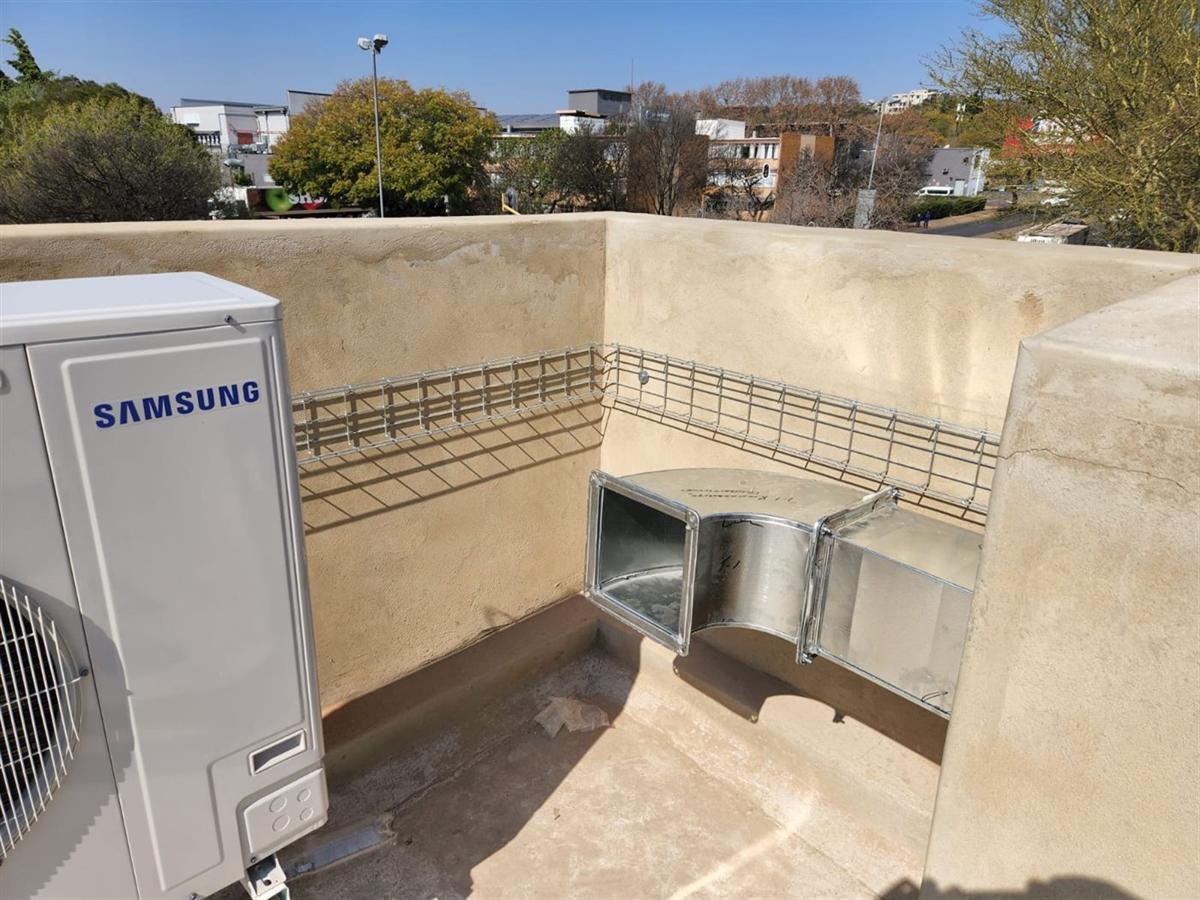
For buildings that can’t just stop
If your air conditioning failing means your shop is unbearable, your server room overheats or your stock spoils, ad hoc call-outs are the wrong model. A maintenance agreement means we hold your site details, know your plant, and arrive on a schedule instead of in an emergency.
- Fixed visit schedule agreed up front, diarised by us
- Asset register of every unit on site, with model and serial numbers
- Written condition report after each visit
- Faults flagged early, while they are still small
- Priority response for plan customers when something does go wrong
Book a service if you notice any of these
Weaker airflow
Usually a blocked filter or a fouled evaporator coil, not a dying unit.
Musty smell
Microbial growth on a damp coil or a blocked condensate drain.
Water dripping inside
Blocked drain line or a frozen coil melting. Stop using it and call.
Higher electricity bill
A dirty condenser makes the compressor work far harder for the same cooling.
What customers ask us
What actually happens during an aircon service?
We strip and wash the indoor filters, clean the evaporator coil and blower wheel, flush and treat the condensate drain, wash down the outdoor condenser coil, check refrigerant pressures and superheat against the manufacturer figures, tighten electrical terminations, measure running current, and test the controls. You get a written report of what we found and anything that needs attention.
How much does a service cost?
It depends on unit type, how many units are on site and how accessible they are - a cassette in a four-metre ceiling needs different equipment to a wall split in a bedroom. Multiple units at one address are cheaper per unit, and maintenance-plan customers pay less than ad hoc call-outs. Call us with how many units you have and what type, and we will give you a number.
My aircon smells musty when it starts up. Is that fixable?
Almost always, yes. That smell is microbial growth on a wet evaporator coil and in the drain tray - common in humid coastal conditions. A standard filter clean will not shift it. It needs a proper chemical coil clean and drain treatment, which is part of our deep-clean service. If the smell returns quickly, the real problem is usually drainage or a unit that is oversized and never running long enough to dry its own coil.
Will skipping services void my warranty?
It can, and manufacturers do enforce it. Nearly every brand makes warranty cover conditional on documented servicing at the stated intervals. If a compressor fails at month twenty and you cannot produce service records, you may well be paying for it yourself. Keep the reports we issue - they are the evidence.
What a service actually measures
Cleaning is the visible part of a service. The diagnostic readings are the part that tells you whether the system is healthy, and they are the part a cheap service omits.
| Reading | What it tells us | Typical warning sign |
|---|---|---|
| Superheat | Whether the evaporator is being fed correctly | High superheat suggests undercharge or a restriction |
| Subcooling | Charge level and condenser performance | Low subcooling points to undercharge or a leak |
| Running current | How hard the compressor is working | Creeping upward year on year means a fouling coil |
| Air-on / air-off split | Actual cooling being delivered | A narrowing split means lost capacity |
| Capacitor value | Remaining life in a wear part | Drifting below rating predicts a start failure |
Recording these every visit turns a service from a clean into a trend. A unit whose running current has risen 15% over three years is telling you something long before it fails, and acting on that is far cheaper than replacing a compressor.
Indoor air quality, not just temperature
An air conditioner recirculates the same air through a coil that is wet for much of its running life. That is an ideal environment for microbial growth, and it is why a neglected system can measurably worsen the air in a room rather than improve it.
Filters are the first defence and the most neglected. A loaded filter does not merely restrict airflow: once it is saturated, particulate bypasses it and lands on the evaporator coil, where it combines with condensate to form a layer that is far harder to remove. That is the point at which a routine clean becomes a chemical coil clean.
In environments where air quality genuinely matters - clinics, food preparation, laboratories, offices with high occupancy - filter grade should be specified deliberately rather than inherited from whatever the unit shipped with.
Refrigerant regulation and your obligations
Refrigerants are controlled substances. South Africa is a party to the Montreal Protocol and the Kigali Amendment, which means the phase-down of high global-warming-potential gases is a legal trajectory, not a trend.
- R22 is phased out. Supply is scarce and expensive, and systems running it should be planned for replacement rather than repeated repair.
- R410A remains common but is itself subject to long-term phase-down pressure.
- R32 is now standard on much new equipment, with roughly a third of the global warming potential of R410A.
- Deliberately venting refrigerant is both an environmental offence and a waste of money. Recovery equipment exists for a reason.
If you run commercial refrigeration, keep a refrigerant log. Record every charge, top-up and recovery. It is good practice, it is increasingly expected at audit, and it is the fastest way to spot a slow leak that would otherwise cost you a compressor.
Building a maintenance budget that is not a guess
Most businesses budget for air conditioning reactively, which means it appears as an unpredictable cost in whichever month something breaks. It does not have to.
An asset register with the age, duty and service history of every unit lets you forecast properly: which units are approaching end of life, which are costing more each year to run, and which should be replaced in a planned window rather than in an emergency during a heatwave when lead times are longest and prices highest.
That shift - from reactive repair to planned replacement - is usually worth more than any discount on an individual service visit.